
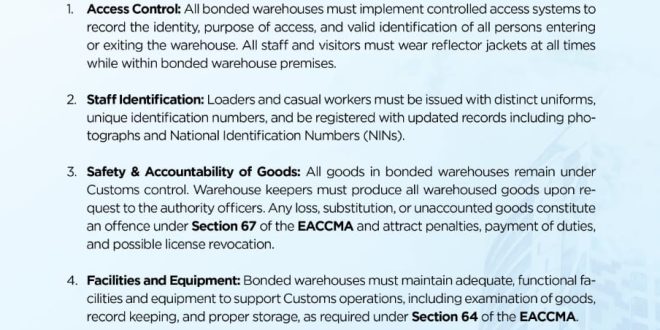
The Uganda Revenue Authority has issued a public notice announcing the enforcement of strict guidelines for all licensed Customs Bonded Warehouse operators across Uganda. The authority says these measures aim to improve accountability, security, and compliance in the management of bonded warehouses. The new rules take effect immediately and are expected to strengthen overall operations in this vital sector.
One of the key requirements is access control. All bonded warehouses must now implement systems to monitor and record every person entering or leaving the premises. Staff and visitors must provide valid identification and clearly state the purpose of their visit. Reflector jackets are mandatory for everyone while inside the warehouses to ensure visibility and safety.
Staff identification is another priority. Loaders and casual workers are required to have distinct uniforms and unique identification numbers. The URA also requires warehouse operators to maintain up-to-date records of all employees, including photographs and National Identification Numbers (NINs), to guarantee proper tracking and accountability.
The authority emphasizes that all goods in bonded warehouses remain under Customs control at all times. Warehouse keepers are expected to produce any items immediately upon request by URA officers. Any loss, substitution, or unaccounted goods is considered an offence under Section 67 of the East African Community Customs Management Act (EACCMA) and can lead to penalties, payment of duties, and even revocation of licenses.
Facilities and equipment are also under scrutiny. Warehouses must maintain functional equipment and adequate infrastructure to support Customs operations, including goods examination, proper storage, and record-keeping as required under Section 64 of the EACCMA. This ensures that operations are smooth and compliant with regulations.
The URA will actively monitor compliance through inspections and evaluate warehouse operations using Key Performance Indicators (KPIs). These assessments will play a major role in determining the renewal of bonded warehouse licenses for 2027 and beyond. Operators who fail to meet the standards risk enforcement actions, penalties, and automatic cancellation of their licenses.
Licensed warehouse operators are urged to take immediate steps to align their operations with these new guidelines. The URA highlights that compliance is not optional, and strict adherence will protect both operators and the integrity of Customs processes.
The notice, first published on Tuesday, February 24, 2026, marks a significant effort by the URA to ensure that bonded warehouses operate under clear, enforceable, and secure standards. It reflects the government’s broader commitment to developing Uganda’s trade and revenue systems.
For further details, operators and stakeholders can contact the URA through their toll-free lines at 0800-117000 or 0800-217000, visit the official website at www.ura.go.ug, or email services@ura.go.ug. Additionally, the URA offers support via WhatsApp at 0772140000, making it easier for warehouse operators to access guidance on compliance.
These new regulations come at a time when Uganda is seeking to improve transparency, reduce losses, and ensure that trade operations run smoothly. By enforcing stricter guidelines, the URA hopes to prevent misuse of bonded warehouses and secure revenue collection.
Operators are expected to review their current practices immediately. Implementing proper access control systems, updating staff records, and ensuring all equipment and facilities meet standards are critical steps. Failing to do so could result in severe consequences under the law.
The URA’s proactive approach is designed to instill confidence among businesses, Customs officers, and the public. By maintaining strict oversight, the authority aims to protect the integrity of bonded warehouses and ensure goods are handled responsibly.
In addition to inspections, KPIs will measure operational efficiency, compliance with safety protocols, and accuracy in record-keeping. These indicators will provide a clear picture of which warehouses meet the URA’s standards and which need improvement.
The authority also stresses that adherence to these guidelines is essential for maintaining the safety and security of warehouse personnel and visitors. Reflector jackets and controlled access systems are not just regulatory requirements—they are crucial for preventing accidents and unauthorized access.
Losses or mismanagement of goods in bonded warehouses not only affect the operators but also the national revenue. By enforcing strict guidelines, the URA aims to minimize such risks and maintain a secure supply chain.
Operators who maintain high standards will benefit from smoother license renewal processes and continued trust from both the URA and the wider business community. Conversely, non-compliance could disrupt operations and result in financial penalties.
The URA encourages all operators to see the guidelines as an opportunity to improve their operations. Proper systems and accurate record-keeping not only protect the business but also build credibility with clients and the government.
By taking immediate action, warehouse operators can avoid penalties and demonstrate their commitment to lawful and responsible management. This approach will also ensure that Uganda’s bonded warehouse sector remains competitive and reliable.
The URA’s enforcement measures reflect a broader trend in governance where transparency, accountability, and operational integrity are prioritized. These actions align with national goals of improving trade management and revenue collection.
Warehouse operators are reminded that compliance is continuous. Regular updates to staff records, equipment maintenance, and adherence to access protocols must become routine practices.
Ultimately, the URA’s guidelines seek to safeguard goods, protect personnel, and maintain high standards of service. Licensed warehouse operators who embrace these changes will contribute to a stronger, more secure trading environment in Uganda.
Developing Uganda Together, as the notice states, requires collaboration between the government, business operators, and the public. By following these guidelines, warehouse operators play a crucial role in ensuring the smooth flow of goods while upholding national standards.


