
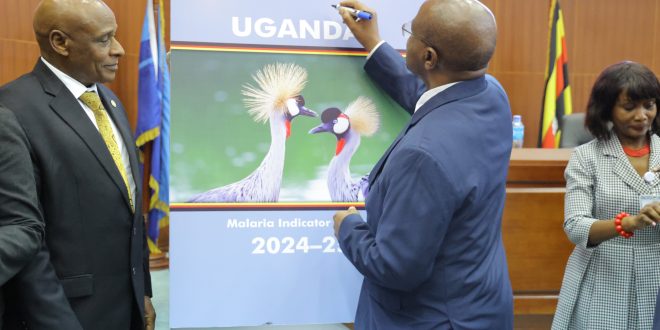
The Uganda Bureau of Statistics (UBOS) has officially released the Malaria Indicator Survey (MIS) Report 2024/25, providing important insights into how Ugandans are preventing malaria and how widely mosquito nets are being used across the country. The report was launched during a dissemination event at the UBOS conference hall and officiated by Amos Lugoloobi, the State Minister for Finance and Planning. The survey findings highlight both the progress Uganda has made in malaria prevention and the areas where more effort is still needed.
According to the survey, about 84 percent of Ugandans own at least one Insecticide Treated Mosquito Net (ITN). This shows that mosquito net distribution campaigns have been largely successful in reaching households across the country. Interestingly, the ownership of mosquito nets is higher in rural areas than in urban areas, where malaria risk tends to be lower. Regional differences were also observed. Teso recorded the highest mosquito net ownership at 95 percent, followed by Lango at 92 percent, while Kampala had the lowest rate at 69 percent.
The report also reveals that most Ugandans received their mosquito nets through government-led mass distribution campaigns. Nearly 90 percent of respondents said they obtained their nets through these campaigns. Other sources included antenatal care visits, community health workers, government health facilities, schools, and local shops. These different distribution channels have played a key role in ensuring that even vulnerable groups can access mosquito nets.
When it comes to actual usage, the survey shows encouraging but mixed results. About 84 percent of pregnant women reported sleeping under an insecticide-treated mosquito net on the night before the survey. Meanwhile, 76 percent of all household members said they slept under a mosquito net, and 78 percent of children under five years were reported to have slept under one. Health experts emphasize that consistent use of mosquito nets is essential, especially for young children and pregnant women, who are more vulnerable to malaria.
The survey also provides important demographic insights. It found that 48 percent of Uganda’s population is below the age of 15, highlighting the country’s young population. In addition, women head about 30 percent of households, showing the growing role women play in family leadership and decision-making across the country.
Another malaria prevention method highlighted in the report is Indoor Residual Spraying (IRS), where insecticides are sprayed inside homes to kill mosquitoes. However, the survey shows that only 10 percent of households nationwide received indoor spraying in the past 12 months. Usage was slightly higher in rural areas at 12 percent, compared to 8 percent in urban areas. The practice is most common in the West Nile region, where malaria transmission remains high.
The report also mentions Seasonal Malaria Chemoprevention (SMC), a strategy where children are given preventive malaria medicine during high-risk seasons. This approach is particularly widely used in the Karamoja region, where malaria cases tend to increase during certain times of the year.
Overall, the Malaria Indicator Survey 2024/25 provides valuable information that will help the Ministry of Health Uganda and its partners improve malaria prevention programs across the country. While the high ownership of mosquito nets shows significant progress, the report also reminds Ugandans of the importance of consistent use and additional prevention methods to further reduce malaria infections nationwide.


