
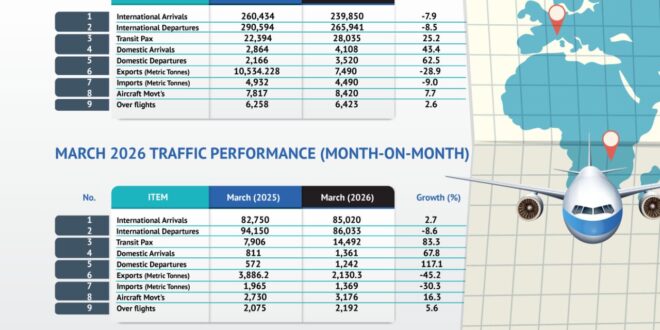
Air traffic activity at Entebbe International Airport during the first quarter of 2026 presented a noticeable shift compared to the same period in the previous year. The months of January through March, typically marked by steady movement of passengers and cargo, instead reflected a more restrained pace.
This change has drawn attention from aviation stakeholders and economic observers alike.Passenger numbers on international routes experienced a decline, signaling reduced travel demand across key destinations.
Airlines operating through Entebbe adjusted to the changing dynamics, with some scaling back frequencies or consolidating flights to match the evolving situation. The usual buzz associated with peak travel periods appeared somewhat subdued.Cargo traffic also mirrored this downturn, with lower volumes recorded in comparison to the first quarter of 2025.
This reduction affected both imports and exports, disrupting the steady flow of goods that supports trade and business operations. Logistics players were forced to navigate delays and shifting schedules as global supply chains felt the strain.A significant factor behind this trend has been the ongoing situation in the Middle East, which has had ripple effects across global aviation.
Air transport routes and schedules were particularly impacted, creating uncertainty that spilled into March 2026. Airlines had to reroute flights, adjust operations, and respond to emerging risks in the region.The impact of these disruptions was most visible toward the end of the quarter.
March, which often contributes strongly to overall performance, recorded the sharpest slowdown. Both passenger movement and cargo handling dipped further, reinforcing the broader quarterly decline.Despite these challenges, Entebbe International Airport continued to operate efficiently, maintaining safety and service standards. Authorities and airport management remained focused on ensuring continuity, even as external factors influenced traffic levels.
Their efforts helped cushion the impact and sustain operations under pressure.Industry analysts suggest that such fluctuations are not uncommon in a globally connected aviation environment. Events in one region can quickly influence travel patterns and trade flows worldwide. The situation in the Middle East serves as a clear example of how geopolitical developments can shape air traffic trends far beyond their immediate location.
Looking ahead, there is cautious optimism that stability in global conditions could restore growth in passenger and cargo traffic. As airlines adapt and confidence returns, Entebbe International Airport is expected to regain momentum. For now, however, the first quarter of 2026 stands as a reminder of the aviation sector’s sensitivity to global events.


