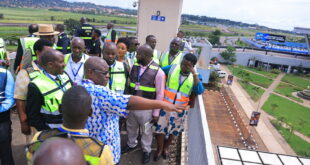
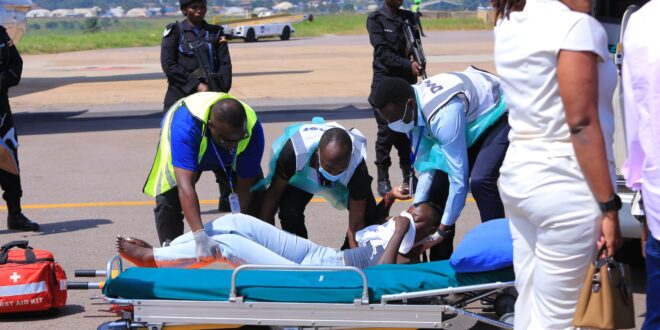
Entebbe International Airport has successfully carried out a full-scale aviation security exercise designed to test how different stakeholders respond to a simulated hijack incident involving a commercial aircraft. The exercise, which took place on Friday, June 26, 2026, was conducted by the Uganda Civil Aviation Authority (UCAA) and brought together multiple agencies responsible for airport safety and security.
The two-and-a-half-hour drill, code-named “EX 2026,” started at around 12:14 pm and simulated a serious emergency involving a Fenna Airlines flight with 67 people on board, including 62 passengers and 5 crew members. According to the scenario, the aircraft was preparing for departure when a hijacker gained access to the cockpit after the pilot briefly stepped out. The hijacker then overpowered the co-pilot and took control of the aircraft before security alerts were raised.
The exercise further included intense emergency procedures such as communication with Air Traffic Control, activation of response systems, ransom demands, and negotiation with the simulated attacker. It was designed to test how well different teams could coordinate under pressure, including security forces, airport management, airline operators, ground handling teams, and medical responders.
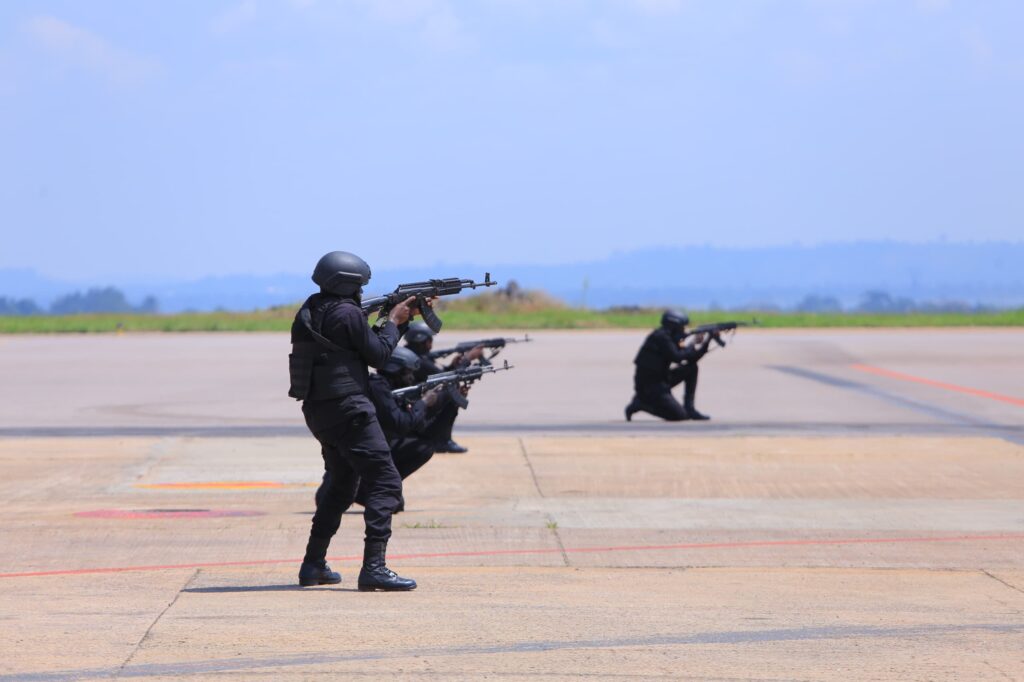
Speaking after the exercise, UCAA Director General Mr. Fred K. Bamwesigye praised all participating teams for their coordination and professionalism. He noted that the drill helped assess how effectively different agencies can respond together during a high-risk aviation emergency. He also confirmed that such exercises are required under international aviation rules to ensure airports remain prepared for potential threats.
The Director General explained that the exercise is part of mandatory requirements set by the International Civil Aviation Organization (ICAO), which requires international airports to conduct such emergency preparedness drills every two years. He added that these activities help improve airport contingency plans and strengthen overall aviation security systems.

After the exercise, all participating stakeholders are expected to hold a debriefing session. This meeting will review what went well and identify areas that need improvement. Officials emphasized that such reviews are important because they help improve future responses and ensure continuous readiness.
UCAA also noted that this was not the first major exercise conducted at Entebbe. The last full-scale security exercise took place in October 2023, while a tabletop exercise was held in 2024. A separate full-scale safety exercise was also carried out in May 2025, showing continued efforts to maintain strong safety standards at the airport.
Despite the exercise, normal airport operations were not affected. Passenger and cargo flights continued as usual throughout the drill, ensuring that travel services remained uninterrupted for the public.
The authority also provided an update on airport performance. In May 2026, Entebbe International Airport recorded 191,642 international passengers in total. This included 94,840 arriving passengers and 96,802 departing passengers, with an average of 6,182 passengers per day. However, this was slightly lower than May 2025, which recorded 196,378 passengers.
Cargo performance also showed a small decline. The airport handled 1,737 metric tons of imports and 3,198 metric tons of exports in May 2026, totaling 4,935 metric tons. This was lower compared to 5,882 metric tons recorded in May 2025.
On the security front, Uganda’s aviation system continues to meet international standards. The most recent ICAO security audit under the Universal Security Audit Programme – Continuous Monitoring Approach gave Uganda a score of 81.6%, which is above the global and regional average.
Overall, the exercise at Entebbe International Airport demonstrated Uganda’s continued commitment to strengthening aviation security, improving emergency response systems, and ensuring that both passengers and cargo operations remain safe and well-managed.