
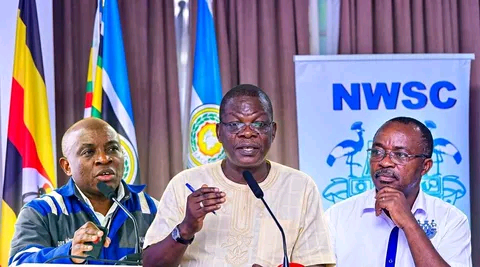
Uganda’s rapidly expanding towns and cities are driving a major push by the National Water and Sewerage Corporation (NWSC) to expand water and sanitation infrastructure and ensure that growing communities can access reliable and safe services.The Corporation outlined its transformation and ongoing investments during a media round table held on Friday, August 14, 2026, at the NWSC International Resource Centre in Kampala. Held under the theme “NWSC Works: Driving Social and Economic Transformation in Uganda,” the engagement examined NWSC’s projects, achievements, service delivery and the challenges created by rapid urban growth.
NWSC Managing Director Eng. Dr Silver Mugisha said the Corporation has undergone significant expansion over the last decade, increasing its presence from 23 towns to about 290 towns. The growth, he said, reflects the increasing demand for improved water and sanitation services across Uganda.The number of NWSC customers has also risen sharply, with connections increasing from approximately 300,000 ten years ago to more than one million today. At the same time, the Corporation’s water network has grown from about 6,000 kilometres to over 25,000 kilometres.Mugisha said the expansion has enabled NWSC to reach communities that previously had limited or no access to reliable urban water services. The Corporation is now extending its infrastructure into emerging urban centres and fast-growing settlements where demand continues to rise.In Kampala and the surrounding metropolitan area, the pace of urbanisation is creating a constant race between infrastructure development and population growth. NWSC General Manager for Kampala Water, Eng. Mahmoud Lutaaya, said the Corporation must continuously extend its systems to keep up with settlements that are expanding into new areas.
Kampala’s ability to meet rising demand has been strengthened by increased water production, particularly following the commissioning of the Katosi Water Treatment Plant in 2021. Katosi currently produces about 160,000 cubic metres of water daily, while Katosi and Gaba together have a combined production capacity of approximately 390,000 cubic metres per day.Lutaaya described water service delivery as a constantly changing challenge, noting that infrastructure must follow population growth rather than remain concentrated in established areas. “Service provision is always a moving target,” he said, highlighting the need for continuous investment if Uganda’s expanding urban population is to receive dependable water and sanitation services.


