
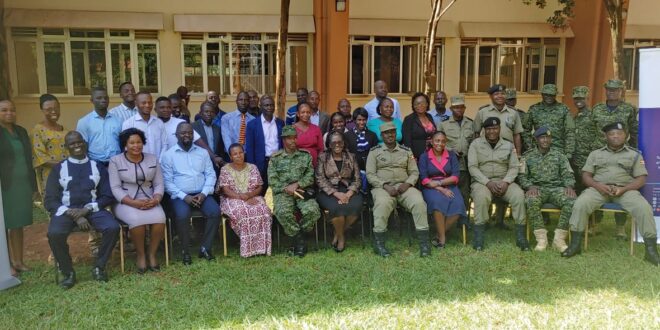
The Uganda Human Rights Commission (UHRC) has stepped up efforts to promote human rights in Uganda’s fishing sector by training fisheries officials and security agencies on how to conduct enforcement operations while respecting the rights and dignity of communities.The two-day training, organised by the UHRC Kampala Regional Office, is taking place at the Civil Service College in Jinja and has brought together Fisheries Management Committee members, Fisheries Officers and security personnel from the UPDF 155 Marine Battalion and the Uganda Police Force serving in Mukono and Wakiso districts.
The participants are being trained in the application of a Human Rights-Based Approach (HRBA), which seeks to ensure that enforcement activities are carried out within the law while protecting the fundamental rights of people working and living in fishing communities.The training was officially opened by the Acting Secretary of UHRC, Mr Byonabye Kamadi, whose remarks were delivered by the Acting Director of Research, Education and Documentation, Ms Rosemary Kemigisha. She appreciated development partners, particularly the European Union and ENABEL, for supporting initiatives aimed at strengthening Business and Human Rights in Uganda.Kamadi said the training would help improve coordination, accountability and referral mechanisms among institutions involved in fisheries management and enforcement.
He reaffirmed UHRC’s commitment to promoting respect for human rights and ensuring that public institutions remain accountable in the execution of their duties.The Head of the UHRC Kampala Regional Office, Ms Juliet Logose, said enforcement agencies must be guided by principles including legality, necessity, proportionality, accountability and non-discrimination. She noted that applying these principles can help agencies enforce fisheries laws effectively without undermining the rights of people in the sector.Participants are also examining human rights concerns affecting the fishing industry and sharing experiences from their respective areas of operation. The discussions are expected to help stakeholders better understand challenges faced by fishing communities and identify practical ways of responding to complaints and other rights-related concerns.
The training is further expected to strengthen cooperation between fisheries officials and security agencies during enforcement operations, while improving accountability and the handling of human rights concerns. The programme continues tomorrow, with participants expected to explore further human rights issues and practical solutions affecting Uganda’s fishing sector.


