
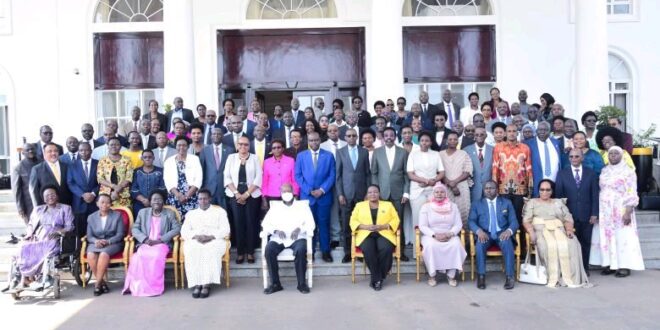
President Yoweri Kaguta Museveni has officially kicked off the work of Uganda’s newly formed government after presiding over the first Cabinet meeting of the 2026–2031 administration. The high-level gathering marked the beginning of a new chapter for the country, with leaders expected to drive forward key government programmes and national development priorities over the next five years.
The meeting was held shortly after the establishment of the new administration and signaled the transition from inauguration activities to the actual business of governing. It provided an opportunity for ministers and senior government officials to begin translating policy commitments into practical action aimed at improving the lives of Ugandans.Prior to the Cabinet session, members of the executive participated in a comprehensive induction retreat at the National Leadership Institute in Kyankwanzi.
The programme brought together both seasoned and newly appointed ministers to sharpen their understanding of government objectives, leadership responsibilities, and the expectations attached to public service.The retreat also focused on strengthening unity within government and ensuring that all leaders are working toward the same national vision. Participants were guided on strategic planning, accountability, ethical leadership, and the broader goals that will shape the administration’s direction during the 2026–2031 term.
The inaugural Cabinet meeting attracted some of the country’s most influential leaders, including Vice President Jessica Alupo and Prime Minister Robinah Nabbanja. Senior ministers, ministers of state, deputy prime ministers, and other top government officials were also present as the administration charted its course for the years ahead.Also in attendance were NRM Secretary General Richard Todwong, Kampala Capital City Authority Executive Director Sharifah Buzeki, senior presidential advisers, and permanent secretaries from various ministries.
Their participation underscored the importance of coordination between political leaders and technical government institutions.Observers view the meeting as a crucial milestone because it formally launched collective government operations under President Museveni’s renewed mandate.
With national expectations high, Cabinet members are expected to focus on economic growth, service delivery, infrastructure development, job creation, and other priority sectors identified by the administration.As Uganda enters a fresh five-year political cycle, the 83-member Cabinet now carries the responsibility of implementing government policies and delivering tangible results. The first meeting not only set the tone for the administration’s ambitions but also signaled the beginning of what leaders hope will be a transformative period for the country’s development and progress.


