
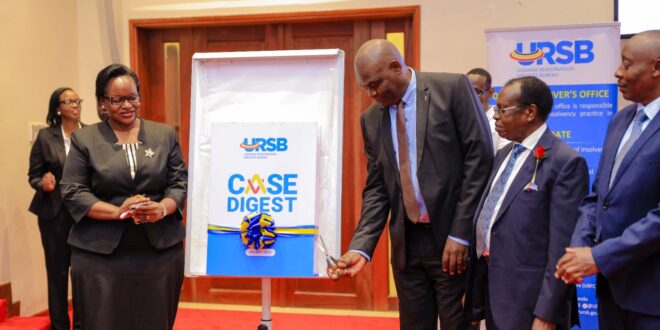
The Uganda Registration Services Bureau (URSB) is strengthening its contribution to Uganda’s commercial justice system by expanding the use of Alternative Dispute Resolution (ADR) and exercising its quasi-judicial mandate to provide businesses and other stakeholders with faster, affordable and accessible avenues for resolving disputes.The development is highlighted in the newly published URSB Case Digest, Volume II, 2026, which brings together selected decisions made by the Bureau as well as relevant court decisions.
The publication provides lawyers, businesses, regulators and other practitioners with practical guidance on how laws administered by URSB are interpreted and applied in real commercial disputes.URSB Board Chairman, Rt. Hon. Amb. Francis K. Butagira, said the Bureau’s quasi-judicial function plays an increasingly important role in supporting Uganda’s business environment. He noted that the mechanism enables the Bureau to resolve disputes, correct irregularities in company records and protect the legitimate interests of both businesses and the wider public.The Case Digest demonstrates the Bureau’s growing focus on maintaining accurate, credible and dependable business registers while ensuring that disputes are handled fairly and transparently. This is particularly important for investors and companies because unresolved disputes involving ownership, management or corporate records can disrupt operations and weaken confidence in the business environment.URSB Registrar General Ms. Mercy K. Kainobwisho said commercial disputes involving intellectual property, company shareholding, management, governance and membership can have significant economic consequences when they are allowed to persist.
She explained that the Registrar’s quasi-judicial powers provide parties with an accessible and cost-effective forum through which such disputes can be addressed.The Bureau is also using ADR and other administrative processes to reduce the time and financial costs associated with commercial disputes. By offering alternatives to prolonged litigation, the mechanisms can help businesses maintain operations while providing parties with practical avenues for resolving disagreements.Cases contained in the Digest cover a wide range of corporate and commercial matters, including shareholder disputes, contested share transfers, corporate governance, rectification of company registers and minority oppression. In one case, the Registrar ordered the rectification of a company register after determining that documents purportedly used to appoint a director and allot shares had not been properly authorised.
The publication is therefore more than a record of past decisions; it is a resource intended to promote consistency, transparency and predictability in Uganda’s commercial legal environment. By making selected decisions available to the public, URSB is giving businesses and legal practitioners a clearer understanding of its mandate while reinforcing its role in protecting registry integrity, resolving disputes and creating a more predictable environment for investment and business growth.


