
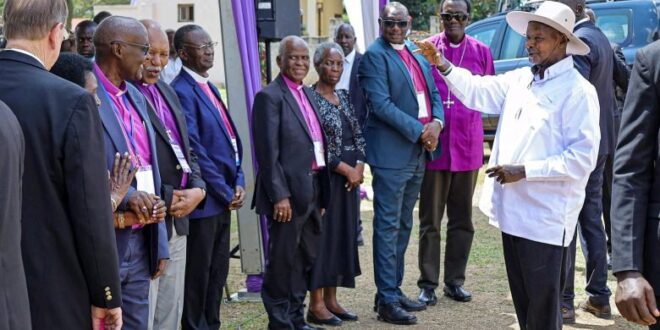
President Yoweri Kaguta Museveni has praised the East African Revival for its lasting contribution to the moral, social and economic development of Ankole, saying the movement helped reshape communities over the last nine decades. Museveni made the remarks at St. John’s Cathedral, Ruharo, in Mbarara City, where he joined Christians and religious leaders to mark 90 years since the Revival took root in Greater Ankole under the theme, “Jesus Christ is the same yesterday, today and forever,” from Hebrews 13:8.
Museveni said the Revival confronted a number of social problems that had affected communities, including alcoholism, adultery, dishonesty, superstition, poor hygiene and harmful cultural practices. He said the Balokole movement also encouraged discipline, education, responsible Christian conduct and healthier lifestyles. According to the President, its influence went beyond preaching and prayer, becoming part of the broader transformation of families and communities across Ankole.
The President also reflected on his personal history with Ruharo and the Church of Uganda, describing his return to the cathedral as a deeply meaningful experience. He recalled visiting the compound for the first time 77 years ago and said his great-grandfather and grandfathers had initially refused to join the Church after missionaries arrived in Ankole in 1899. Museveni said it was only his father, mother and himself who eventually joined the Church in 1947 at Kinoni.Museveni shared childhood memories of returning to Ankole with his parents and sister, Dr. Kajubiri, in 1949 during celebrations marking 50 years of the Church’s presence in the region. He recalled an amusing incident in which he became separated from his parents after following a woman wearing clothing with a pattern similar to his mother’s. He said he later returned to Ankole with his father in 1953 and came back again in 1959 to join Junior Secondary One, where prayer was part of their everyday life.Turning to the social impact of the Revival, Museveni said the movement played a major role in confronting alcohol abuse, which he described as a serious problem in Ankole at the time.
He recalled visiting a brewery established by South Africans and being told that Mbarara had been identified through research as an important market because of the number of alcohol consumers in the area. He added that the Revival challenged tobacco use, adultery and promiscuity while promoting family responsibility, honesty and good hygiene.Museveni urged the Church to continue combining spiritual work with initiatives that improve people’s economic wellbeing. He welcomed efforts by religious leaders to promote agriculture and other development programmes, while encouraging residents to protect wetlands and water catchment areas. He warned that environmental destruction was contributing to water shortages, particularly in River Rwizi, and urged communities to embrace irrigation and modern farming without degrading the natural environment.The President also supported a proposal to establish an East African Revival museum, saying it would preserve the history of the movement and document its contribution to Uganda and humanity. Retired Archbishop Luke Orombi thanked Museveni for supporting religious institutions and called on leaders to allow righteousness to guide their decisions. Bishop Fred Sheldon Mwesigwa of Ankole Diocese said the 90th anniversary should inspire communities to revive the values of the movement, particularly as the region continues to face challenges such as alcohol abuse and HIV/AIDS.
The East African Revival emerged in the early 1930s after British missionary Dr. Joe Church met African civil servant Simeon Nsibambi and later spread from Gahini in Rwanda to Kigezi and Ankole. Evangelists from Gahini, including Blasio Kigozi, Paul Gahunde and Yosiya Kinuka, arrived in Ankole on January 8, 1936, helping ignite a movement centred on repentance, reconciliation, restitution and practical Christian living. Its influence eventually extended into education, health, hygiene, work and community values, with the anniversary celebrations bringing together President Museveni, bishops, their spouses and elderly Christians whose lives were shaped by the Revival.


