
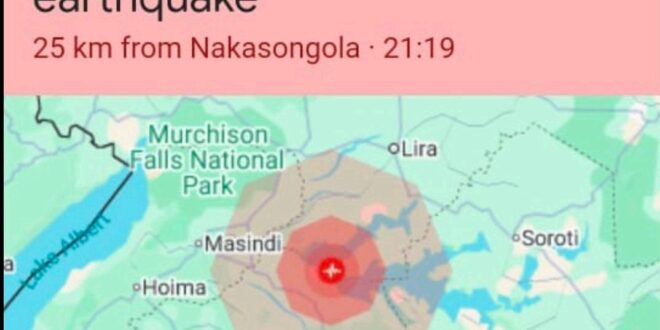
A late-night earthquake measuring 4.5 magnitude sent shockwaves across Uganda on Sunday, startling thousands of residents and reminding the nation of its position within one of Africa’s most active geological zones. The tremor was felt in several regions, making it one of the most widely experienced seismic events in recent times.
International seismic monitoring agencies reported that the earthquake struck at around 9:19 p.m. local time. Data from the United States Geological Survey and other monitoring platforms placed the magnitude at approximately 4.5, with the epicentre identified near Nakasongola in central Uganda.
Although moderate in strength, the earthquake occurred at a shallow depth, allowing the shaking to travel efficiently across the surface.
This geological characteristic amplified its reach, enabling people hundreds of kilometres away from the epicentre to feel the tremors.
Reports of shaking emerged from Kampala and neighbouring districts before spreading to eastern towns such as Jinja and parts of western Uganda. Residents in sections of northern Uganda also reported mild tremors, highlighting the broad impact of the seismic disturbance.
Many people described moments of panic as homes, offices and other structures shook unexpectedly. Several residents said they heard deep rumbling noises before the ground began to move, while others rushed outdoors fearing a stronger earthquake could follow.
Uganda sits within the Albertine Rift, a branch of the East African Rift System where powerful tectonic forces continue to reshape the continent. The movement of massive underground plates frequently generates earthquakes, making seismic activity a recurring reality for communities living along the rift.
The country has witnessed stronger earthquakes in the past, including the devastating magnitude 7.2 event recorded in May 1990 near the Uganda–DR Congo border. That earthquake remains the most powerful ever linked to Uganda’s seismic zone and stands as a landmark event in the nation’s geological history.
While authorities had not immediately reported significant damage or casualties, experts continue to monitor the area for potential aftershocks. The latest earthquake serves as a stark reminder that beneath Uganda’s landscape, powerful natural forces remain constantly at work, capable of producing sudden and far-reaching tremors.


