
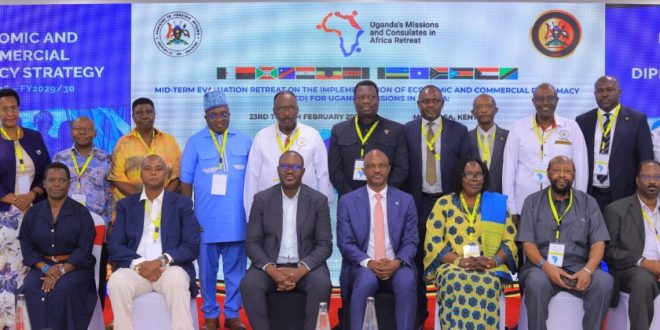
Uganda has stepped up its drive to align foreign policy with national economic ambitions, directing its diplomatic missions across Africa to prioritize trade expansion, investment attraction, tourism promotion, and technology partnerships. The renewed momentum came during a strategic mid-term review of the country’s Economic and Commercial Diplomacy (ECD) Strategy convened in Mombasa, Kenya.
The three-day evaluation, held from February 22 to 24, 2026, brought together ambassadors and heads of mission to assess implementation progress and sharpen performance targets. The ECD framework, launched in Gulu in August 2025, is a collaborative effort between the Ministry of Finance, Planning and Economic Development and the Ministry of Foreign Affairs to integrate diplomacy into Uganda’s broader economic transformation agenda.
Permanent Secretary Vincent Bagiire Waiswa called for a results-oriented diplomatic corps capable of generating measurable commercial impact. He emphasized that embassies must move beyond protocol and focus on expanding export markets, identifying credible investors, boosting tourist arrivals, and collecting reliable market intelligence to support domestic producers.
To strengthen coordination and data-driven decision-making, Bagiire announced plans to establish an ECD hub and secretariat jointly overseen by the two ministries. The hub will consolidate information gathered by missions, enhance research capacity, and provide analytical support to improve Uganda’s competitiveness within regional and global markets.
Also present at the retreat, Secretary to the Treasury Ramathan Ggoobi described Uganda’s foreign missions as frontline economic outposts tasked with accelerating growth. He stressed that diplomatic engagements should be assessed by their contribution to improved market access and increased foreign direct investment.
Ggoobi framed the review as a strategic performance audit aimed at identifying effective missions, successful approaches, and operational gaps requiring urgent intervention. He noted that productive initiatives will be expanded and adequately resourced, while less effective strategies will be redesigned to ensure stronger outcomes.
Participants were urged to capitalize on opportunities under the African Continental Free Trade Area, which links a market of approximately 1.5 billion people across the continent. Officials highlighted Africa as Uganda’s primary economic springboard, emphasizing that strengthening intra-African trade is essential before scaling into broader global markets.
The Ministry of Finance reaffirmed its commitment to provide sustained technical and financial backing to missions abroad. In response, diplomats pledged to adopt clearer commercial targets, define priority sectors, identify potential buyers and investors, and implement measurable action plans. Leaders expressed confidence that a sharper fusion of diplomacy and commerce will significantly advance Uganda’s prosperity in the coming decade.


