
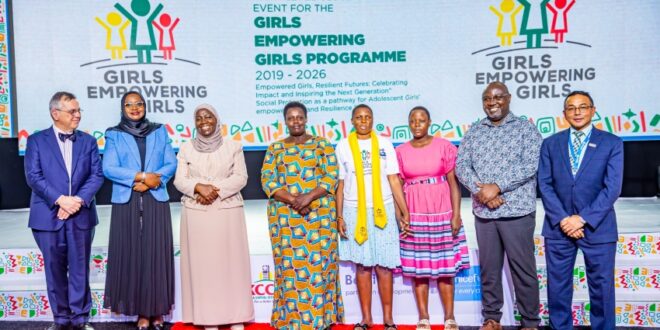
After seven years of dedicated effort, the Girls Empowering Girls (GEG) programme, led by the Kampala Capital City Authority (KCCA) in partnership with UNICEF and the Government of Belgium, has officially concluded. The initiative, which aimed to empower vulnerable adolescent girls in Kampala, has been hailed as a revolutionary model for urban social protection, leaving a lasting impact on the lives of those it touched.
The programme’s closure was marked by a high-profile ceremony held at City Hall, presided over by Vice President Jessica Alupo. Under the theme “Empowered Girls, Resilient Futures,” the event celebrated the achievements of the GEG programme and inspired both the beneficiaries and the broader community to continue striving for progress.Launched in 2019, the GEG programme focused on girls from marginalized backgrounds, including those at risk of dropping out of school or facing multidimensional poverty.
It offered a comprehensive approach that combined educational support, vocational training, and economic opportunities, all aimed at creating sustainable pathways for the future of these young women.In her speech, Vice President Alupo commended the programme’s success and encouraged the girls to maintain their commitment to education and the skills they had gained.
“These girls must remain dedicated to their studies and use their newfound abilities to drive change in their communities,” she said. “This programme demonstrates that investing in girls is an essential part of national development.”KCCA Executive Director Sharifah Buzeki spoke passionately about the programme’s transformative impact on the city, emphasizing both the tangible and intangible results. She highlighted that over 800 girls had been re-enrolled in school, while more than 200 had completed vocational training, and 35 of the programme’s beneficiaries had even launched their own businesses. Buzeki reflected on the broader social impact, noting that the programme had helped restore the dignity of many girls who had been overlooked by society.Belgium’s Ambassador to Uganda, Hugues Chantry, offered a perspective on the broader significance of the programme’s closure.
“Although it may seem like the end of something, this moment is a milestone to celebrate,” he remarked. He stressed that the success of GEG should serve as an inspiration for future initiatives aimed at gender equality and social cohesion, reaffirming Belgium’s ongoing commitment to supporting education and social protection efforts in Uganda.Dr. Robin Nandy, UNICEF’s representative to Uganda, underscored the scale and inclusivity of the programme, revealing that over 4,000 girls had been reached through its two cohorts. With a specific focus on the most vulnerable populations, including teenage mothers, out-of-school girls, and refugees, the programme has become a model for future interventions targeting disadvantaged girls in urban environments.As GEG comes to a close, its legacy will live on through the policy lessons and strategies developed over its course. These insights will continue to inform efforts aimed at ensuring that girls in urban areas have the support they need to access education, build skills, and achieve economic independence.
The success of GEG provides a hopeful blueprint for future empowerment initiatives, both within Uganda and beyond.This remarkable programme, widely recognized as the first of its kind in Uganda, has shown the power of collaboration and holistic approaches to social change. Through the combined efforts of KCCA, UNICEF, the Government of Belgium, and other development partners, GEG has provided a strong foundation for the future of thousands of young girls in Kampala.


