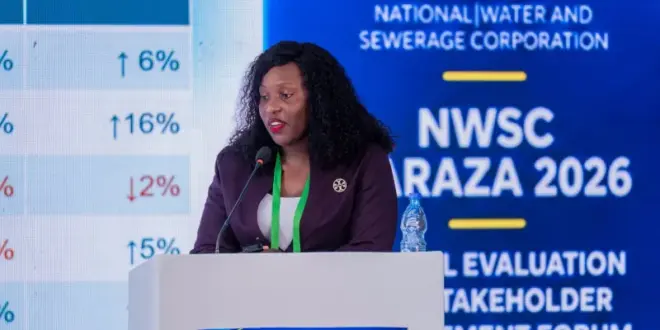
The National Water and Sewerage Corporation (NWSC) has expanded its water distribution network by 1,024 kilometres in the 2025/2026 financial year, more than doubling its annual target as it intensifies efforts to bring safe and reliable water closer to millions of Ugandans. The achievement highlights the corporation’s continued investment in water infrastructure to meet the growing demand across the country.The impressive performance was announced during the NWSC Baraza 2026 held at IREC Bugolobi, where the corporation presented its achievements, addressed service delivery concerns and engaged stakeholders on improving water access.
Anna Nyadoi, NWSC’s Principal Economist, revealed that the corporation achieved 205 per cent of its target after surpassing the planned 500-kilometre network extension under its Strategic Plan 2025–2030.NWSC also registered 62,226 new water connections against an annual target of 60,000, increasing the number of customers connected to its supply system. Consequently, its customer base grew from approximately 1.004 million to 1.064 million connections, while the population receiving its services increased from 19 million to 22 million people, representing 105 per cent achievement of its target.
Managing Director Dr Silver Mugisha said the growing population and rapid expansion of urban centres were increasing pressure on existing water infrastructure. He explained that NWSC must continue extending its networks, installing larger pipes and upgrading ageing systems to ensure that new residential and commercial developments receive adequate water supplies. The corporation has expanded from serving just three designated towns to operating in 293 urban centres across Uganda.Mugisha emphasised that expanding distribution networks must be accompanied by increased water production capacity to guarantee consistent supplies. He also called for stronger cooperation between NWSC, local leaders and communities to identify pressing needs, resolve service delivery challenges and ensure that infrastructure investments benefit the public.
The corporation plans to conduct stakeholder engagements every six months to review progress and develop practical solutions to emerging concerns.Despite the progress, NWSC continues to face operational challenges, particularly water losses and inadequate supply in some areas. Non-revenue water increased from 33.7 per cent to 34.4 per cent, missing the target of reducing losses to 32 per cent. Such losses can result from leaking pipes, illegal connections, inaccurate meters and other inefficiencies. The corporation will need to strengthen leak detection, improve metering systems and address illegal connections to minimise wastage and protect revenue.
Financially, NWSC recorded an annual turnover of Shs 678 billion, achieving 119 per cent of its target and registering a five per cent increase over the baseline year. Its infrastructure asset base also grew from approximately Shs 4.8 trillion to Shs 5 trillion. Meanwhile, the Customer Engagement Index improved from 79 per cent to 82 per cent, exceeding its target, while the employee engagement index stood at 78.2 per cent, equivalent to 98 per cent achievement of its target.
However, inadequate water production affected network expansion in some parts of Kampala and the Central Region, underscoring the need for additional investment in production and distribution facilities.Held under the theme “Water for All; For Health and Prosperity,” the NWSC Baraza 2026 reinforced the corporation’s commitment to expanding access to safe, reliable and affordable water. Mugisha described access to water as a basic human right and appealed for public cooperation during pipeline installation and other infrastructure works, including road excavations. As NWSC implements its 2025–2030 Strategic Plan, its major priorities include expanding coverage, reducing water losses, strengthening financial sustainability and improving service reliability to ensure that more Ugandans benefit from dependable water and sanitation services.