
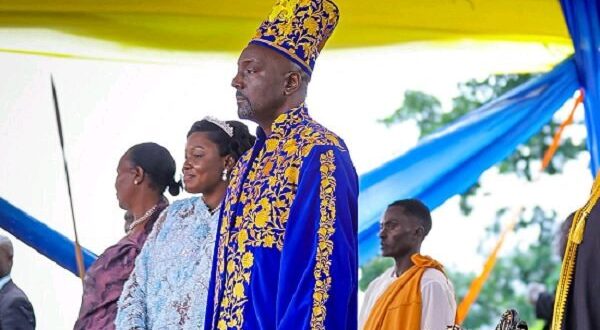
The decision by Prince Edward Rukidi Kiijanangoma to take the throne name Omukama Nyabongo I has sparked curiosity across Tooro and beyond, with many people asking why the new king abandoned his personal name for a title deeply rooted in the history of Uganda’s ancient kingdoms. According to historians, the name was carefully chosen and carries a connection to the shared history of Tooro and Bunyoro, as well as the circumstances surrounding the latest royal succession.
The story stretches back to the 19th century, when Tooro broke away from the Bunyoro-Kitara Kingdom. Crown Prince Kaboyo Olimi Kasunsunkwanzi, who was expected to inherit the Bunyoro throne from his father, Omukama Nyamutukura Kyebambe III, rebelled and eventually established Tooro as a separate kingdom. Kaboyo became its first Omukama, but the separation did not break the historical and family ties between the two royal houses. Instead, Tooro and Bunyoro remained connected through the Babiito royal lineage.
It is this shared history that provides an important clue to the choice of Nyabongo. Historian and journalist Wilson Akiiki Kaija explains that when Kaboyo refused to return to Bunyoro and claim the throne, his father chose another son, Mugenyi, to succeed him. Mugenyi later became the 20th Omukama of Bunyoro-Kitara and adopted the name Nyabongo II. The name recognised an earlier Bunyoro ruler who had also been known as Nyabongo, creating a royal naming tradition that has now found a new chapter in Tooro.
There are also striking similarities between the circumstances surrounding Mugenyi’s rise to the Bunyoro throne and those surrounding Kiijanangoma’s selection as the new Omukama of Tooro. Mugenyi became king as a mature man after his father had ruled for many years, while Kiijanangoma ascended the Tooro throne at the age of 56. According to Kaija, the elders also viewed Mugenyi as a man associated with humility, obedience and responsibility, qualities they similarly identified in Kiijanangoma.
The recent succession process itself added another historical parallel. Before Mugenyi became king of Bunyoro, his brother Kaboyo had rejected the opportunity to succeed their father and instead founded Tooro. In the latest Tooro succession, the Babiito Clan Succession Committee initially considered Prince George Desmond Kamurasi, who reportedly declined the opportunity for personal reasons. Kiijanangoma subsequently emerged as the preferred candidate, a development that the elders saw as echoing the circumstances that once surrounded Mugenyi’s rise to the Bunyoro throne.
Kiijanangoma’s selection was not based solely on his royal blood. The 21-member Babiito Clan Succession Committee assessed three candidates using several criteria covering social, cultural, economic, political and cognitive qualities. The elders considered character, reputation, knowledge of Tooro customs, financial responsibility, ability to work with kingdom institutions, education and willingness to learn. On September 9 at Karuziika Palace, Kiijanangoma was formally announced as the selected successor to the late Omukama Oyo Nyimba Kabamba Iguru Rukidi IV.
The new king’s journey to the throne was further marked by traditional and institutional ceremonies. During the burial of King Oyo at the Karambi Royal Tombs on September 12, Kiijanangoma performed the Iziba rite by casting nine coffee berries into the grave of his predecessor, a ceremony symbolising the transfer of royal authority. Three days later, the Tooro Kingdom Supreme Council unanimously endorsed him, strengthening the legitimacy of his succession and paving the way for his emergence as Omukama Nyabongo I.
For Kiijanangoma, therefore, Nyabongo I is much more than a new name. It is a bridge between the history of Bunyoro and Tooro, a reminder of the Babiito dynasty’s complicated royal journey and a reflection of the circumstances that brought him to the throne. After spending much of his professional life as a journalist, news anchor and editor telling the stories of others, the 56-year-old prince is now writing his own chapter in Tooro’s history. The elders have given him the name Nyabongo I, but it is his reign that will ultimately determine the legacy that name carries.


