
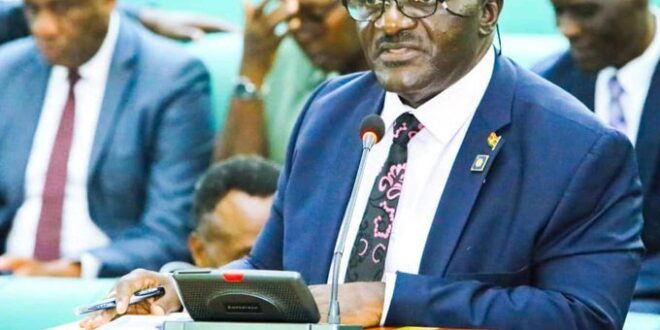
The Ministry of Works and Transport in Uganda has put forward a bold proposal to secure 8.3 trillion shillings for the 2026/27 financial year, marking a 40% increase in the current budget allocation. This ambitious funding request, made by Transport Minister Gen. Katumba Wamala, is designed to revive stalled projects, clear mounting arrears, and push forward vital national infrastructure initiatives, including the Kampala-Jinja Expressway and the Standard Gauge Railway.
The Ministry emphasizes that this investment is crucial for achieving a modern, safe, and efficient transport network across the country.
A significant portion of the requested funds, 4.17 trillion shillings, is designated for the road sub-sector, which has been severely impacted by delayed payments and unpaid debts to contractors. These financial setbacks have caused many major road projects to stall. To resolve these issues, approximately 758 billion shillings will be allocated to resume delayed road works, while 338 billion shillings will go toward acquiring land for the long-delayed Kampala-Jinja Expressway, where right-of-way disputes have further complicated progress.
The road network overhaul is not limited to national highways. The Ministry has also proposed a short-term solution to alleviate traffic congestion in Kampala, with 44 billion shillings earmarked for addressing the ongoing gridlock at the Busega junction. An additional 25 billion shillings is set aside for constructing interchanges at Busabala and Kigo. These measures are part of a broader plan to improve urban mobility and ease the pressure on Kampala’s increasingly overwhelmed transport infrastructure.
Beyond the capital, the Ministry is focusing on upgrading key regional roads, such as the 92km Muyembe-Nakapiripirit road and the 100km Apac-Lira-Puranga road. These projects are seen as vital for enhancing connectivity in underserved regions. In addition, the proposal includes plans to rehabilitate over 55km of deteriorating national roads to ensure that critical routes remain functional and safe for users.
The proposal also calls for a substantial increase in funding for rural roads, with an additional 330 billion shillings allocated to improve access to remote districts. This investment is aimed at promoting inclusive growth by ensuring better connectivity between rural communities and urban centers, thereby boosting economic opportunities in rural areas.
In addition to road infrastructure, the Ministry is pushing forward several aviation and rail projects. A significant 126.9 billion shillings is requested to complete the Kabalega International Airport terminal, which is nearing its final stages of construction. The terminal is expected to improve Uganda’s aviation capacity, enhancing its global connectivity. Furthermore, 145 billion shillings are earmarked for supporting Uganda Airlines’ operations, while the government is also making progress on the Tororo-Gulu meter gauge railway, which is already 66% complete.
However, the proposed budget has faced criticism from some lawmakers who question the allocation of such large sums, especially for projects that are already near completion.
Committee Chairman Tony Awany raised concerns over the 126 billion shillings requested for the Kabalega Airport terminal, suggesting that the cost may have been inflated. MP Sarah Opendi also criticized the continued funding of Uganda Airlines, arguing that the money could be better spent on the railway system, which she views as a more critical investment for the country’s future.
Despite the pushback, the Ministry of Works has warned that without the necessary funding, the cycle of delayed projects and rising compensation costs will only worsen. As the fiscal year draws closer, the debate over how to best allocate resources for Uganda’s infrastructure development remains at the forefront of parliamentary discussions, with the future of several key projects hanging in the balance.


