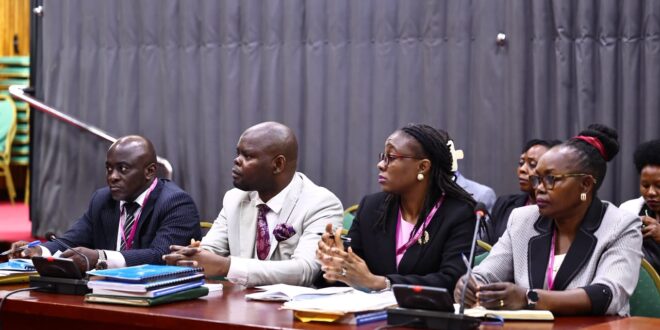
The Uganda Human Rights Commission (UHRC) has defended its complaints-handling procedures following scrutiny of a report by Parliament’s Committee on Commissions, Statutory Authorities and State Enterprises (COSASE), chaired by Kyadondo East MP Muwada Nkunyingi. The Commission has cited its 2015 Complaints Handling Procedures Manual to explain how human rights complaints are investigated, closed and appealed, raising questions about the recommendations concerning its officials and the handling of cases.
The controversy follows COSASE’s examination of the Auditor General’s report for the financial year ended December 31, 2025. The audit covered procurement, asset management, revenue performance, implementation of the Commission’s strategic plan, complaints management and inspections of detention facilities. However, an analysis challenging aspects of the parliamentary findings questions whether some recommendations adequately considered the Commission’s established procedures and whether the inquiry extended into administrative and legal matters beyond its primary oversight responsibilities.
A major point of contention is the closure of human rights complaints and the responsibilities of Pauline Nansamba Mutumba, the Director of Complaints, Investigation and Legal Services. Section 6.5 of the UHRC’s 2015 manual empowers Regional Human Rights Officers to close complaint files at different stages of the process. The manual also requires complainants to be notified when the Commission cannot proceed with a case and informed of their right to appeal to the Director. Regional offices must also submit monthly reports documenting closed complaints and explaining the reasons for those decisions.Section 6.6 outlines the Director’s authority to review recommendations from regional offices.
Within the prescribed process, the Director may approve a recommendation to proceed, amend or supplement the proposed action, or return a file for further investigation or alternative measures. Section 15.8 further assigns the Director responsibilities that include reviewing files, supervising complaints management, ensuring timely decisions and receiving reports on the disposal of cases. These provisions have become central to arguments that responsibility for closed complaints should be assessed against the Commission’s established decision-making framework.
The manual also establishes an internal appeals mechanism through which complainants can challenge certain administrative decisions. Under Sections 13.1.1 and 13.1.2, appeals may be lodged against decisions by regional officers or the Director, including decisions to close files or offer alternative remedies. Depending on the decision being challenged, the matter may proceed to the Director or the Chairperson for further review. In response to questions raised on social media, UHRC maintained that regional officers and the Director have powers relating to the closure of complaints under the manual. The Commission also stated that parliamentary committees had been informed about these procedures and that the manual is publicly available.The COSASE recommendations concerning allegedly irregularly closed complaints have raised further questions about whether individual cases were examined in sufficient detail before responsibility was assigned.

The analysis challenging the report argues that reopening complaints should involve a careful review of the circumstances surrounding each decision, the evidence available and the procedures followed. It also raises concerns about the practical implications of reopening cases in an institution already facing a backlog and operating with limited resources. However, the existence of an established complaints-handling manual does not automatically prove that every decision was properly made, making case-by-case examination important.Questions have also been raised about recommendations concerning the Commission’s leadership and the scope of the parliamentary inquiry.
Rule 187 of Parliament’s Rules of Procedure provides for the examination of reports and audited accounts of statutory authorities, consideration of the Auditor General’s recommendations and reporting findings to Parliament. Critics of aspects of the COSASE report question whether all its conclusions remained within that framework, particularly where administrative and legal matters were considered. The handling of an earlier sitting that the Commission’s Chairperson reportedly failed to attend has also attracted attention after an arrest warrant was reportedly issued before she appeared the following day.The COSASE report is expected to be considered by the full Parliament alongside the report of the Legal and Parliamentary Affairs Committee, providing an opportunity for lawmakers to examine the findings and the Commission’s response.
The key issue is whether the recommendations are supported by sufficient evidence and are consistent with the legal framework governing UHRC. While parliamentary oversight remains essential for ensuring accountability in public institutions, the Commission’s 2015 manual provides an important reference for understanding how complaints are handled, closed and appealed. Establishing whether wrongdoing occurred will ultimately require scrutiny of the individual cases, the decisions made and the evidence supporting the conclusions reached.
When contacted yesterday for a comment on the findings about the closure of cases, a senior officer who preferred not to be named before the report is debated, shared with us their Human Rights Complaints Handling manual urging that the finding was erroneous.