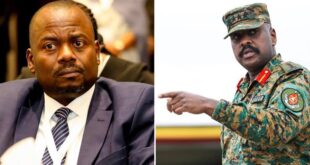
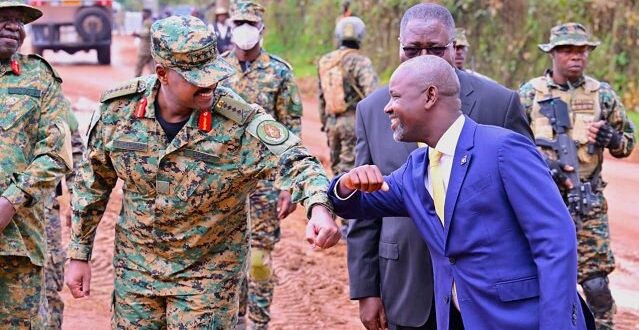
The growing debate surrounding Chief of Defence Forces (CDF) Gen. Muhoozi Kainerugaba’s involvement with the Patriotic League of Uganda (PLU) has taken another turn, with political commentator Morrison Rwakakamba dismissing allegations that the army chief is unlawfully directing a political movement while still serving in the military.In an opinion article, Rwakakamba challenged arguments recently presented by lawyer Asuman Kiyingi in The Observer, where Kiyingi questioned the legality of Muhoozi’s leadership of PLU and suggested that his political activities could violate the Constitution, the Political Parties and Organisations Act and the UPDF Act.Kiyingi had argued that President Yoweri Museveni’s October communication to the NRM Central Executive Committee provided important evidence of an alleged constitutional breach.
He maintained that Muhoozi’s position as CDF was incompatible with directing a political organisation, particularly one increasingly associated with discussions about Uganda’s political future and succession.However, Rwakakamba argued that the allegations were based on a misunderstanding of the legal status and activities of PLU. He maintained that the organisation operates as a civic pressure group within the broader NRM political environment rather than as an independent political party.According to Rwakakamba, civic organisations and pressure groups have a legitimate role in influencing public opinion, mobilising citizens and engaging with political developments. He argued that PLU’s registration activities, regional mobilisation and endorsement campaigns do not automatically transform it into an illegal political party.He also pointed out that several public activities associated with PLU, including regional launches, rallies and other mobilisation events, have largely been organised by supporters. Rwakakamba argued that gatherings organised by supporters should not automatically be interpreted as military operations or formal directives issued through the UPDF command structure.On the constitutional question, Rwakakamba maintained that the requirement for the armed forces to remain non-partisan should not be interpreted as completely removing the individual civic rights of serving military officers.
He referred to constitutional provisions protecting fundamental rights and argued that a distinction must be made between institutional military involvement in politics and an individual’s private civic associations.He further relied on Section 97 of the UPDF Act, arguing that the requirement for an officer to leave military service becomes particularly relevant when the officer formally seeks political office. In his view, discussions about possible future endorsements or political ambitions do not necessarily mean that the legal threshold for resignation has already been reached.Rwakakamba also challenged the way Kiyingi interpreted previous court decisions involving military officers and political participation. He argued that cases involving partisan activities within the military or the conduct of army representatives in Parliament should not automatically be extended to cover every political association outside military institutions.The commentator further questioned the argument that Muhoozi’s political ambitions amount to an attempt to establish a family dynasty. He noted that there has been no formal constitutional process through which Muhoozi has been handed the presidency, adding that anyone who eventually seeks the country’s highest office would still have to contend with Uganda’s electoral laws and voting process.
Beyond the legal arguments, Rwakakamba called for a more practical national conversation about Uganda’s political future, arguing that the country should focus on institutional stability, electoral reforms and peaceful leadership transitions instead of concentrating entirely on individual personalities.He cited the proposed Consociational Democracy Agreement (CDA), associated with Gen. Caleb Akandwanaho, commonly known as Salim Saleh, and Professor Ogenga Otunnu, as an example of efforts to encourage dialogue between political actors with different ideological positions.Rwakakamba argued that the proposed arrangement could provide a platform for wider consultations, power-sharing discussions and constitutional reforms. He suggested that an inclusive national dialogue would help address disagreements surrounding military participation in politics, political associations and future leadership transitions.
He also questioned the Uganda Law Society’s approach to the matter, arguing that while the professional body has the right to raise constitutional concerns and call for investigations, decisions on prosecution and legal accountability should remain with the constitutionally mandated institutions.

In his conclusion, Rwakakamba maintained that the controversy surrounding Muhoozi and PLU exposes wider questions about Uganda’s constitutional framework that cannot be settled through accusations and demands for prosecution alone.He argued that the country needs clearer laws governing the relationship between military service, individual political rights and civic organisations, while strengthening democratic institutions to prepare for future leadership transitions.The debate over Muhoozi’s role in PLU therefore remains part of a wider national discussion about the military’s place in politics, the future of the NRM and the constitutional principles that should guide Uganda’s next political chapter.