
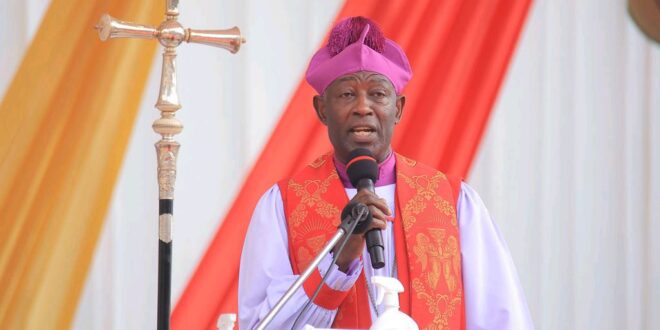
The growing disagreement between the Church of Uganda and the breakaway Reformed Anglican Church has taken a fresh turn, with the mainstream church warning the new Anglican faction against using its hymns, vestments, liturgical practices and other religious symbols in a manner that could mislead the public.
The dispute comes as the Reformed Anglican Church continues to expand its activities in northern Uganda and prepares to launch the headquarters of its West Acholi Diocese in Amuru District.
The new diocese is expected to unveil its headquarters at Lwalakwar Village, Lacor Parish, in Lamogi Sub-county, Kilak South County. The function is expected to be presided over by Rev Prof Jonathan Kyangasha, the Archbishop of the Reformed Anglican Church Province of Uganda.
The planned launch is another indication of the growing presence of the Reformed Anglican Church in northern Uganda, where the group says it has established several congregations in a relatively short period.
Rev Patrick Lumumba, the Reformed Anglican Church coordinator for the Acholi region, said the group has already planted churches in Gulu City, Gulu, Amuru and Omoro districts.
Lumumba described the Reformed Anglican Church as an evangelical, apostolic and sacramental church whose teachings are based on the Holy Scriptures and Christian Creeds.
He further claimed that the church had established 11 congregational churches in West Acholi within one month, signalling what he described as a rapid expansion of the new Anglican movement in the region.
But the developments have not been welcomed by the mainstream Church of Uganda, which has moved to publicly distance itself from the activities of the Reformed Anglican Church.
The Diocese of Northern Uganda recently issued a statement warning Christians and members of the public that the Reformed Anglican Church is not affiliated with the Church of Uganda.
Rev Samuel Kidega, the Diocesan Secretary for the Diocese of Northern Uganda, said the diocese had become aware of the presence and activities of the Reformed Anglican Church in different parts of northern Uganda.
He stressed that the Church of Uganda has no relationship with the breakaway group and does not share its mission programmes.
The diocese also warned religious leaders, government officials, development partners, local communities and church members to exercise caution when dealing with individuals or organisations claiming to represent or operate under the Church of Uganda.
According to the diocese, activities such as church planting, fundraising, ordinations, appointments and other programmes organised by the Reformed Anglican Church should not be taken as having the endorsement, approval or participation of the Church of Uganda.
The dispute has also extended to the use of Anglican worship materials and religious symbols.
The Church of Uganda says it has been concerned about what it describes as the continued unauthorised use of its identity, hymns, liturgical practices and clerical vestments by members of the Reformed Anglican Church.
Rev Canon William Ongeng, the Provincial Secretary of the Church of Uganda, said the use of vestments similar to those worn by Church of Uganda clergy and bishops could create confusion among Christians and the wider public.
Among the items mentioned are clerical collars, cassocks, episcopal shirts, pectoral crosses, mitres, croziers and other ecclesiastical insignia.
Ongeng argued that the use of such items by people who are not licensed or recognised by the Church of Uganda could amount to serious misrepresentation.
The Church of Uganda has consequently warned that it could pursue legal action if the alleged misrepresentation continues.
According to Ongeng, the church wants to protect the integrity of its identity, doctrine and worship traditions and prevent members of the public from being misled into believing that the Reformed Anglican Church is part of the mainstream Church of Uganda.
The Reformed Anglican Church, however, has strongly challenged the position of the Church of Uganda.
Rev Canon Kisakye Zac Kalimi, the Provincial Secretary of the Worldwide Anglican Church in Uganda, argued that the Anglican tradition is much broader than any single Anglican province.
Kalimi said Anglican liturgy, hymns, episcopal vestments and other ecclesiastical traditions existed for centuries before the establishment of the autonomous Church of Uganda.
He maintained that no single Anglican province can claim exclusive ownership of traditions that are shared across the worldwide Anglican Communion unless specific materials are protected by intellectual property rights.
He also noted that many Anglican hymns were composed by Christians from different countries and generations, making them part of a broader Christian heritage rather than the property of one church.
However, Kalimi acknowledged that copyright laws should be respected where a particular hymn or religious material is protected by an individual composer, publisher or rights holder.
He further argued that clerical collars, cassocks, episcopal shirts, pectoral crosses and other similar vestments are widely used by Anglican churches around the world and are therefore not unique to the Church of Uganda.
Despite the increasingly bitter exchange, the Reformed Anglican Church has called for dialogue rather than confrontation.
Kalimi urged Anglican bodies and Christian denominations to concentrate on issues that affect society instead of allowing disagreements over church administration to create deeper divisions.
He said Christians should focus their collective efforts on helping the poor, protecting children and vulnerable people, promoting justice and strengthening families.
The current dispute is rooted in a leadership disagreement that emerged in Kumi Diocese several years ago.
The conflict reportedly began in 2019 following disagreements surrounding the election of Rev Charles Oode Okunya. The situation later escalated when Rev Okunya was consecrated as bishop of the group’s Upper Nile Diocese in 2022.
The disagreement subsequently developed into broader disputes involving church leadership, congregations and properties, resulting in tense confrontations between rival groups.
Senior Church of Uganda officials were at one point prevented from accessing some disputed church premises in Kumi Diocese.
Retired Bishop John Charles Odurkami was later deployed to Kumi in an effort to restore unity among Anglican Christians and stabilise the diocese.
However, the situation remained difficult, with church leaders facing resistance and competing claims of authority.
The latest disagreement over hymns, vestments and Anglican worship traditions has therefore added another dimension to the long-running dispute.
As the Reformed Anglican Church continues establishing congregations in different parts of northern Uganda, the Church of Uganda is insisting that the public must clearly distinguish between the two institutions.
The Reformed Anglican Church, on the other hand, maintains that its use of Anglican traditions is rooted in the wider history of Anglican Christianity and should not be treated as an attempt to impersonate or misrepresent the Church of Uganda.
With both sides maintaining their positions, the dispute could potentially move beyond public statements and into the courts if the Church of Uganda follows through on its warning of legal action.


