
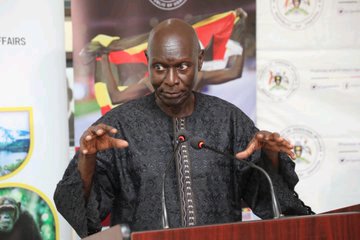
Permanent Secretary Vincent Bagiire has expressed confidence in Uganda’s campaign to have Ambassador Olara Otunnu elected as the next Secretary-General of the United Nations, saying the country has earned the right to provide leadership at the global body.Otunnu’s candidacy has attracted international attention not only because of his extensive diplomatic experience but also because of his historic contribution to the process used to select UN Secretaries-General.
More than four decades ago, while serving as President of the United Nations Security Council in 1981, Otunnu introduced a confidential straw-poll voting system that helped resolve a deadlock over the appointment of a new UN Secretary-General. The method, now widely known as the “Otunnu Formula,” remains a central part of the Security Council’s selection process.At the time, Cold War tensions had divided Security Council members over who should succeed Secretary-General Kurt Waldheim. To break the impasse, Otunnu proposed confidential informal ballots that allowed member states to privately indicate whether they encouraged, discouraged or had no opinion on each candidate.
The approach reduced public confrontation, helped identify broadly acceptable candidates and eventually paved the way for the appointment of Javier Pérez de Cuéllar of Peru.Since then, confidential straw polls have become the standard procedure used by the Security Council before formally recommending a candidate to the UN General Assembly for appointment as Secretary-General.Under the current process, countries first nominate candidates, who then present their vision for the United Nations and engage member states through diplomatic consultations.
The Security Council conducts several rounds of confidential straw polls to assess each candidate’s level of support, with particular attention given to whether any of the five permanent members—China, France, Russia, the United Kingdom and the United States—are likely to exercise their veto power.Otunnu is widely regarded as one of Uganda’s most accomplished diplomats. He previously served as Uganda’s Permanent Representative to the United Nations before becoming a UN Under-Secretary-General and the first Special Representative of the Secretary-General for Children and Armed Conflict. Throughout his diplomatic career, he has been recognised for promoting dialogue and consensus during periods of international tension.With United Nations Secretary-General António Guterres approaching the end of his second term, Uganda has formally nominated Otunnu to succeed him.
Supporters argue that his long diplomatic career, combined with his role in developing the confidential straw-poll system that transformed the UN selection process, makes him well suited to lead the organisation at a time of growing global conflicts and geopolitical divisions.Whether or not his bid succeeds, Otunnu’s contribution to the evolution of UN diplomacy has already secured him a lasting place in the history of the United Nations, with every modern race for Secretary-General continuing to rely on a process that traces its origins to his diplomatic innovation.


