
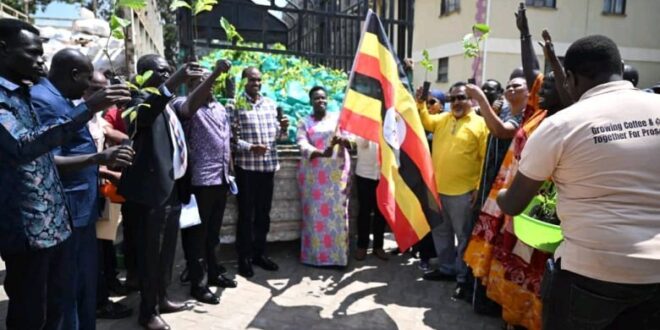
A major agricultural transformation is taking shape in the Teso sub-region as Vice President Jessica Alupo, together with State Minister for Sports Peter Ogwang and Trade Minister Sanjay Tanna, spearheaded the launch of a bold campaign promoting coffee, cocoa, and banana cultivation under the “Ekibalo” wealth creation program in Katakwi District. The initiative, flagged off on June 27, 2026, has been described as a strategic shift aimed at transforming Teso into a major agricultural hub.
During the launch, Minister Peter Ogwang marked a noticeable political shift by publicly pledging closer collaboration with Vice President Alupo, signaling a new era of unity among regional leaders. He emphasized that previous political divisions should give way to collective development efforts, especially in the fight against poverty, which he described as the region’s greatest enemy.
Vice President Alupo, in her address, reinforced the government’s long-term agenda of transitioning Ugandan farmers from subsistence agriculture to commercial production by 2030. She stressed that coffee and cocoa have now become national priority crops, urging communities in Teso to embrace them alongside traditional food crops, while also adopting modern farming techniques such as irrigation, mulching, and soil fertility management.
She further linked the program to the national agricultural transformation agenda driven by President Yoweri Kaguta Museveni, noting that Uganda’s coffee roadmap aims at producing up to 20 million 60-kilogram bags annually by 2030. She encouraged farmers to see Teso’s fertile soils as a competitive advantage capable of positioning the region among the country’s leading coffee producers.
The campaign has also received strong institutional backing from agencies such as Operation Wealth Creation and the Ministry of Agriculture, Animal Industry and Fisheries, led by Frank Tumwebaze. Officials highlighted the massive distribution of improved seedlings across the country and urged farmers in Teso to adopt recommended varieties, particularly Robusta coffee, which is better suited to the region’s climate.Cultural and local leadership also played a central role, with the Iteso Paramount Chief applauding the initiative and calling for every clan to actively participate in coffee planting.
Leaders highlighted ongoing efforts to establish demonstration farms and improve access to quality seedlings, while warning that farmers must also prepare for climate-related challenges such as drought and flooding.Prominent political figures including former minister Godfrey Kiwanda Ssuubi and NRM Vice Chairperson David Calvin Echodu praised the program, citing its potential to restore household incomes and revive the region’s economic stability.
Local leaders like Katakwi LC5 chairperson Geoffrey Omolo also welcomed coffee farming as a long-awaited replacement for declining cotton production.According to agricultural authorities and export data cited by the Ministry, Uganda’s coffee exports have reached trillions of shillings in value, reinforcing the crop’s importance to the national economy. With strong backing from government institutions and growing enthusiasm among farmers, the Teso initiative is increasingly seen as a defining moment in Uganda’s broader push toward agricultural commercialization and rural wealth creation.


